Anhora
How AI assistants are becoming a shoppable surface — and what brands should prepare for next.
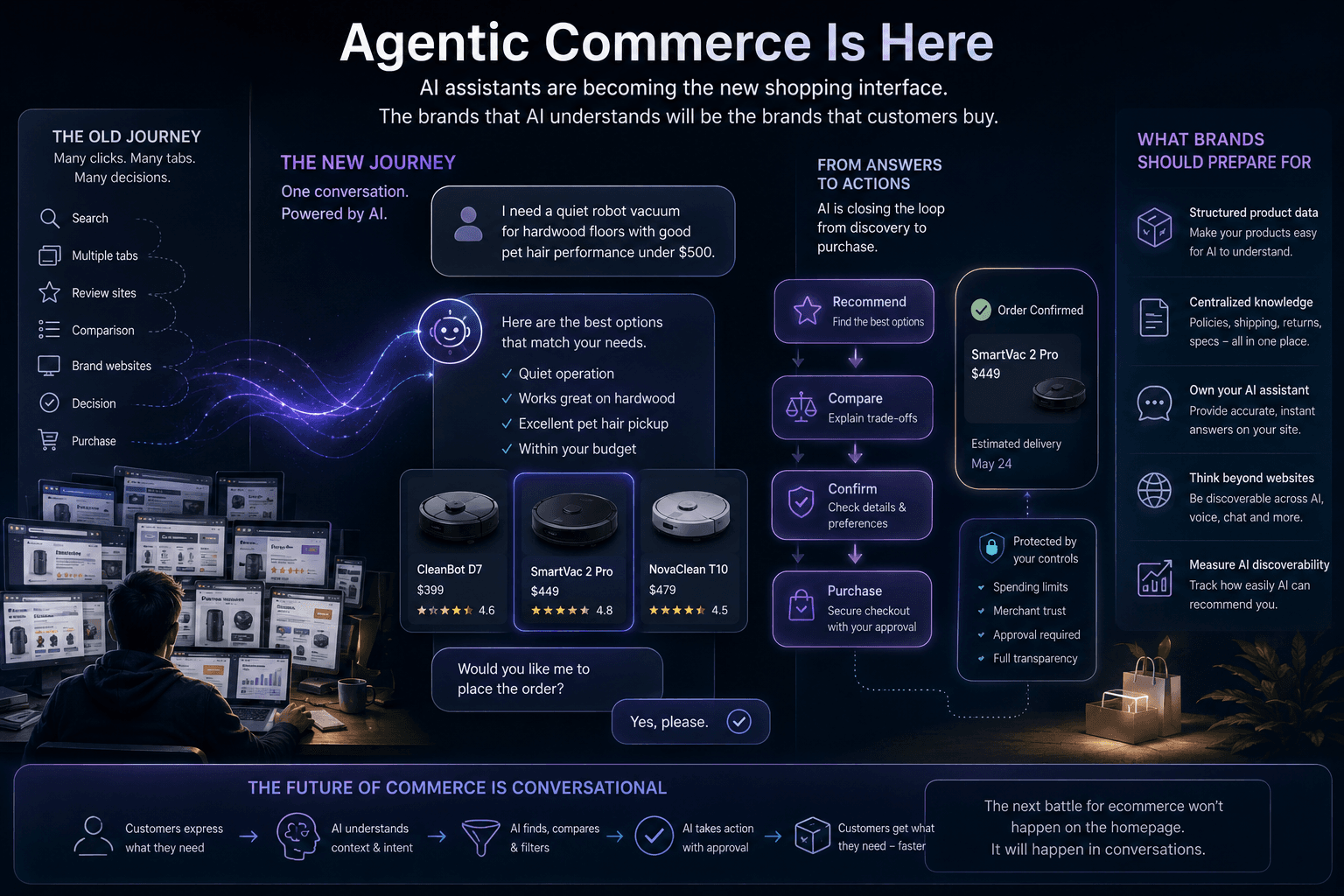
For nearly thirty years, online commerce has followed the same pattern.
A customer discovers a product.
They visit a website.
They browse categories.
They compare options.
They add something to a cart.
They check out.
Every improvement in ecommerce—from better search to personalized recommendations—has optimized this journey.
But the journey itself remained unchanged.
Now that assumption is breaking.
Instead of opening ten browser tabs, consumers increasingly ask an AI assistant:
"Find me a waterproof hiking backpack under $200."
"Which espresso machine is easiest to clean?"
"Order the same coffee I bought last month."
The assistant compares products, filters thousands of options, explains trade-offs, remembers preferences, and increasingly continues all the way to purchase.
That changes something fundamental.
The AI assistant is becoming a new shopping surface.
Not another website.
Not another marketplace.
A completely different interface between customers and brands.
The companies that prepare for this transition early will be much easier for AI to recommend.
The companies that don't may discover that their products have become nearly invisible.
The biggest shift isn't that AI can answer product questions.
Search engines already did that.
Recommendation engines already did that.
The real change is that consumers are beginning to delegate shopping itself.
Instead of searching manually, people increasingly describe goals:
"I need a quiet robot vacuum for hardwood floors with good pet hair performance."
"Buy birthday gifts for two six-year-olds under $80 total."
"Reorder my vitamins every month unless the price increases by more than 10%."
Notice what changed.
People aren't describing products.
They're describing outcomes.
The AI becomes responsible for translating intent into products.
That means discovery starts happening before a customer ever reaches your website.
Industry analysts increasingly describe this transition as agentic commerce—AI systems that help users discover, compare and increasingly purchase products instead of merely answering questions.
Think about how commerce evolved.
Physical stores.
↓
Websites.
↓
Mobile apps.
↓
Social commerce.
↓
Marketplaces.
↓
Search.
↓
AI conversations.
Every generation introduced a new place where buying decisions started.
Today, ChatGPT, Google AI Mode, Microsoft Copilot and similar assistants are increasingly becoming that starting point.
Shopify summarizes the shift in one sentence:
"AI is the new front door to commerce." Shopify
That sentence is more important than it first appears.
Customers may still complete purchases on your website.
But they may never discover your brand there.
Discovery is moving elsewhere.
For years brands optimized for humans.
Beautiful landing pages.
Hero images.
Navigation menus.
Marketing copy.
Category pages.
AI doesn't experience websites the same way humans do.
It cares about:
Human-friendly websites are becoming machine-readable commerce systems.
Shopify notes that many retailers believe they're AI-ready when they actually have product pages designed primarily for human browsing rather than structured reasoning by AI systems. Shopify
This doesn't make SEO obsolete.
It expands it.
Tomorrow's visibility depends not only on whether Google indexes your page.
It also depends on whether AI agents can understand it.
Traditional ecommerce often looks like this:
Search
↓
Ten browser tabs
↓
Review sites
↓
Videos
↓
Comparison tables
↓
Brand websites
↓
Decision
Agentic commerce compresses those steps into one conversation.
Instead of collecting information manually, the customer asks one increasingly capable assistant.
The assistant performs much of the comparison work.
The result is fewer clicks.
Less browsing.
More intent.
Consumers are increasingly using AI to explain products, compare alternatives and evaluate trade-offs before making purchasing decisions, and these conversations are beginning to lead directly to transactions.
Historically brands competed for:
Agentic commerce introduces another competition.
Recommendation eligibility.
Imagine asking:
"Recommend three CRM systems for a growing SaaS company."
The assistant doesn't show twenty blue links.
It might recommend three.
Maybe four.
That changes competitive dynamics dramatically.
Being ranked #8 becomes almost meaningless.
The goal becomes being one of the recommendations.
Until recently, assistants mostly stopped at recommendations.
That boundary is disappearing.
Major commerce and payment companies are building infrastructure that allows AI systems to participate directly in transactions.
During 2026:
We're still early.
Most purchases continue to involve explicit customer approval.
But the direction is clear.
AI is moving from:
finding
↓
explaining
↓
comparing
↓
buying
Interestingly, the biggest obstacle isn't technology.
It's trust.
Consumers are surprisingly willing to receive recommendations from AI.
They become much more cautious when AI starts spending money.
Research from Visa suggests shoppers want visibility into what agents are doing, with approval controls and spending limits remaining essential for adoption.
This means successful agentic commerce won't remove humans.
It will gradually reduce unnecessary decisions while keeping meaningful ones under customer control.
This is perhaps the biggest strategic implication.
Today brands invest heavily in:
If AI intermediaries increasingly guide purchasing decisions, the customer relationship changes.
Payment company Adyen recently warned that merchants risk losing direct consumer relationships as AI shopping assistants increasingly mediate discovery and purchasing, making loyalty and first-party relationships even more valuable.
That doesn't mean brands disappear.
It means they need new ways to remain visible.
Many companies still think product data is back-office infrastructure.
Agentic commerce changes that.
Structured product information becomes part of customer acquisition.
Can an AI answer:
If not, another product may simply be easier to recommend.
The best merchandising increasingly looks like good structured data.
Ironically, the rise of external AI assistants increases the value of internal ones.
Why?
Because customers still visit websites.
They still ask questions.
They still need support.
They still compare products.
The difference is that expectations have changed.
People increasingly expect every company to provide conversational help that understands products, policies and context.
An AI assistant is becoming another digital touchpoint alongside websites, email and mobile apps.
Not replacing them.
Extending them.
Traditional ecommerce optimized interfaces.
Agentic commerce optimizes conversations.
Instead of teaching customers how your website works...
...brands increasingly need systems that understand how customers think.
Natural language becomes a purchasing interface.
This doesn't eliminate catalogs.
It changes how people reach them.
Large catalogs helped when customers browsed manually.
AI changes that.
Recommendation quality depends on understanding.
The assistant needs clear product attributes.
Reliable knowledge.
Consistent policies.
Machine-readable information.
Good answers.
A smaller catalog with excellent structured information may outperform a much larger catalog that AI struggles to interpret.
Fortunately, most preparation has little to do with futuristic AI agents.
It looks surprisingly practical.
Stop treating descriptions as marketing copy alone.
Ensure products expose attributes AI can reason about.
Policies.
Shipping.
Returns.
Compatibility.
Warranty.
Specifications.
If this information is scattered across PDFs and forgotten pages, AI will struggle too.
Customers increasingly expect immediate answers.
An assistant grounded in accurate business knowledge improves customer experience today while preparing the organization for tomorrow's AI ecosystem.
Customers may soon discover your products through:
Treat your website as one channel—not the only one.
Companies already measure:
Soon they'll also ask:
"Can AI assistants accurately recommend our products?"
That will become an increasingly important business metric.
Every major shift in commerce changes the interface.
Search engines changed discovery.
Smartphones changed accessibility.
Social media changed influence.
AI assistants are changing decision-making.
The companies that succeed won't necessarily be those with the most advanced AI.
They'll be the ones whose products are easiest for AI to understand, trust and recommend.
Because in agentic commerce, the first customer evaluating your product may no longer be a person.
It may be another intelligent system acting on someone's behalf.
The next battle for ecommerce won't happen on the homepage.
It will happen inside conversations.
And increasingly, those conversations will end with a purchase.