Anhora
Great AI assistants don't just answer questions—they communicate like your business. Here's why brand alignment matters as much as knowledge.
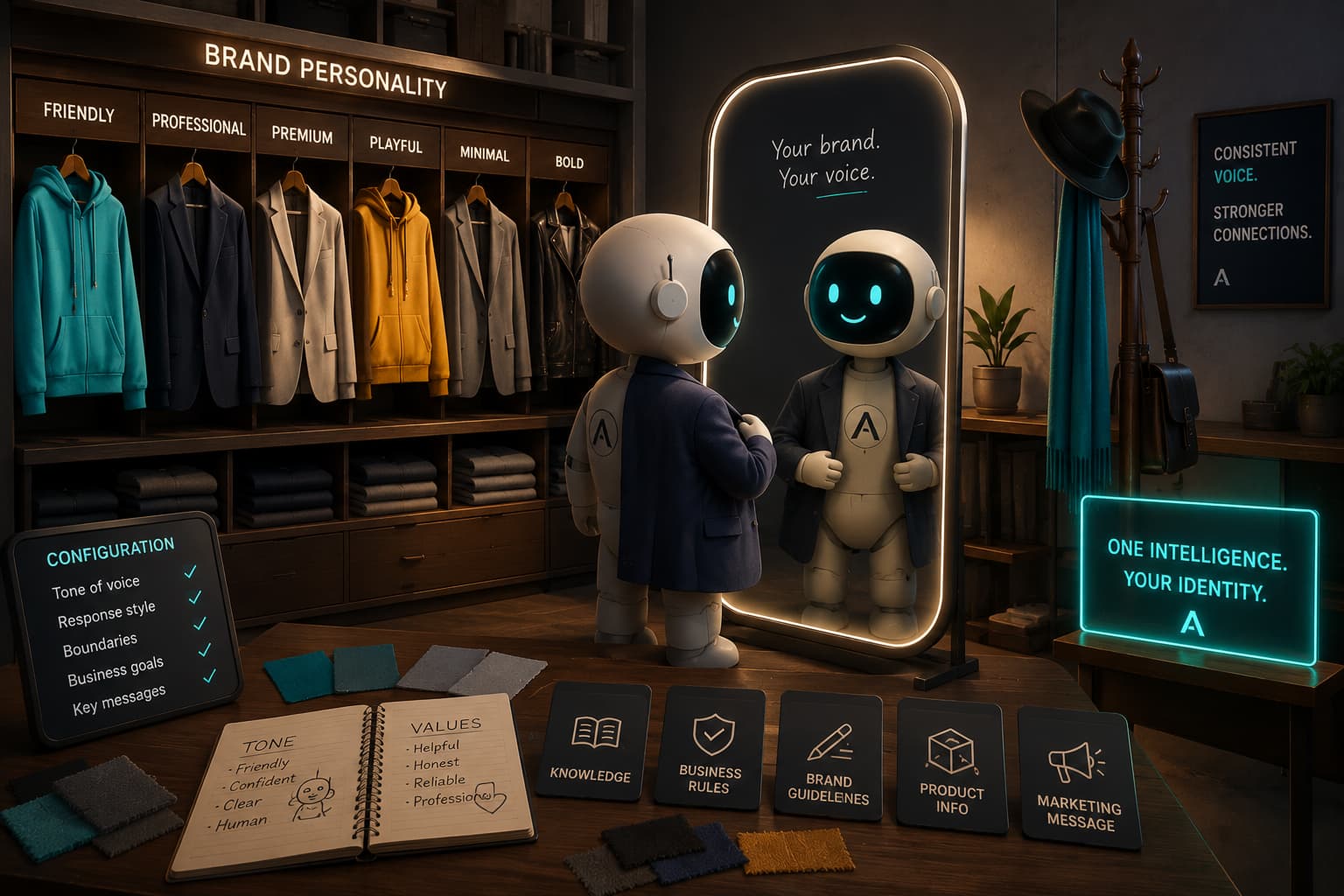
Customers remember what your assistant says. They also remember how it says it.
When businesses first add AI to their websites, the initial goal is often simple: answer customer questions.
At first, that feels like enough.
The assistant understands products, summarizes documentation, and responds within seconds. It seems like the problem has been solved.
But after the first few weeks of real customer conversations, another challenge begins to appear.
The assistant knows the business.
It just doesn't sound like the business.
A company's brand isn't only defined by its logo or color palette.
It's reflected in the way people communicate.
Some businesses are friendly and conversational.
Others are formal and precise.
Some encourage exploration.
Others focus on clear recommendations.
Even simple decisions matter.
Should the assistant say "I recommend"?
Should it compare competitors?
Should it apologize?
Should it offer alternatives when information is unavailable?
None of these answers come from a product catalog.
They come from the business itself.
Modern AI assistants can access documents, product information, FAQs, and internal knowledge.
That's essential.
But two assistants with access to the exact same information can create completely different customer experiences.
One might sound helpful and confident.
Another may sound uncertain.
A third might be overly enthusiastic or inconsistent with the company's tone.
The knowledge is identical.
The behavior is not.
That's why brand alignment cannot be solved by documentation alone.
Unlike a human employee, an AI assistant doesn't take a day off.
It may participate in thousands of conversations every week.
Each response contributes to how customers perceive the company.
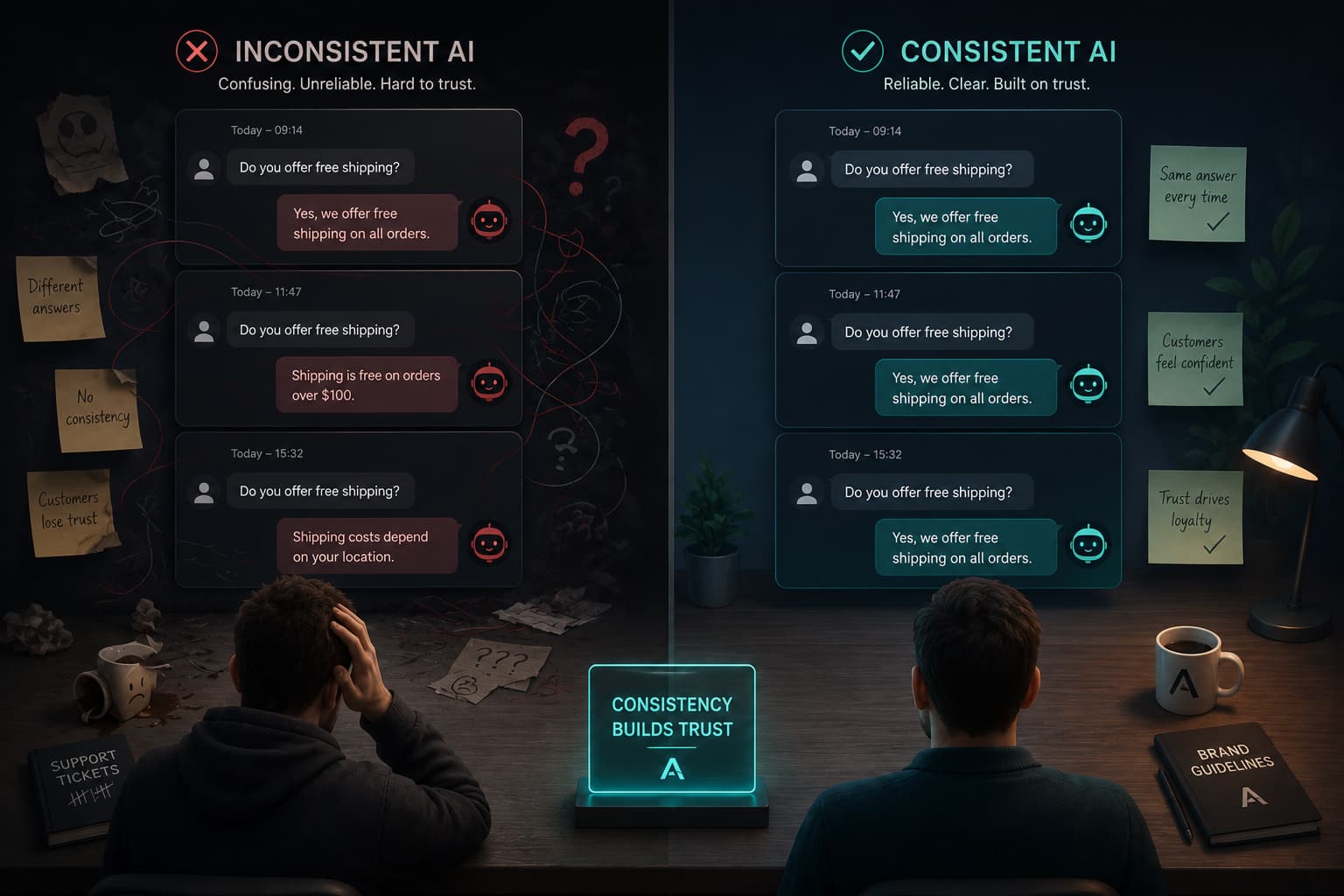
That makes consistency increasingly important.
Customers shouldn't feel like they're speaking with a different assistant every time they ask a similar question.
They should recognize the same tone, the same priorities, and the same level of professionalism across every interaction.
One of the biggest misconceptions about AI assistants is that behavior can be controlled with a single prompt.
That approach works surprisingly well for demonstrations.
It rarely scales.
As businesses grow, assistants need to balance multiple types of information:
Treating all of that as one large prompt quickly becomes difficult to maintain.
A structured configuration makes those responsibilities easier to understand, review, and evolve over time.
Rather than asking an assistant to "be professional," businesses can define what professionalism actually means for their organization.
Every company is different.
A software startup communicates differently than a healthcare provider.
A luxury retailer speaks differently than an industrial manufacturer.
An educational platform answers questions differently than a legal practice.
Expecting one generic AI personality to fit every business simply doesn't reflect how organizations actually communicate.
Configuration allows assistants to adapt without losing consistency.
It gives teams control over how the assistant behaves while keeping that behavior understandable for everyone involved.
The first version of an AI assistant is rarely the final version.
Products change.
Policies evolve.
Marketing messages are updated.
New services are introduced.
An assistant should evolve alongside the business instead of requiring teams to rewrite increasingly complex prompts every few weeks.
That is one of the reasons structured configuration becomes more valuable over time.
It supports continuous improvement without sacrificing clarity.
As AI becomes part of everyday customer interactions, businesses will need more than assistants that simply know the right information.
They'll need assistants that communicate in a way that feels recognizably their own.
Knowledge answers questions.
Brand alignment shapes experiences.
Both matter.
But together, they create assistants customers can trust.
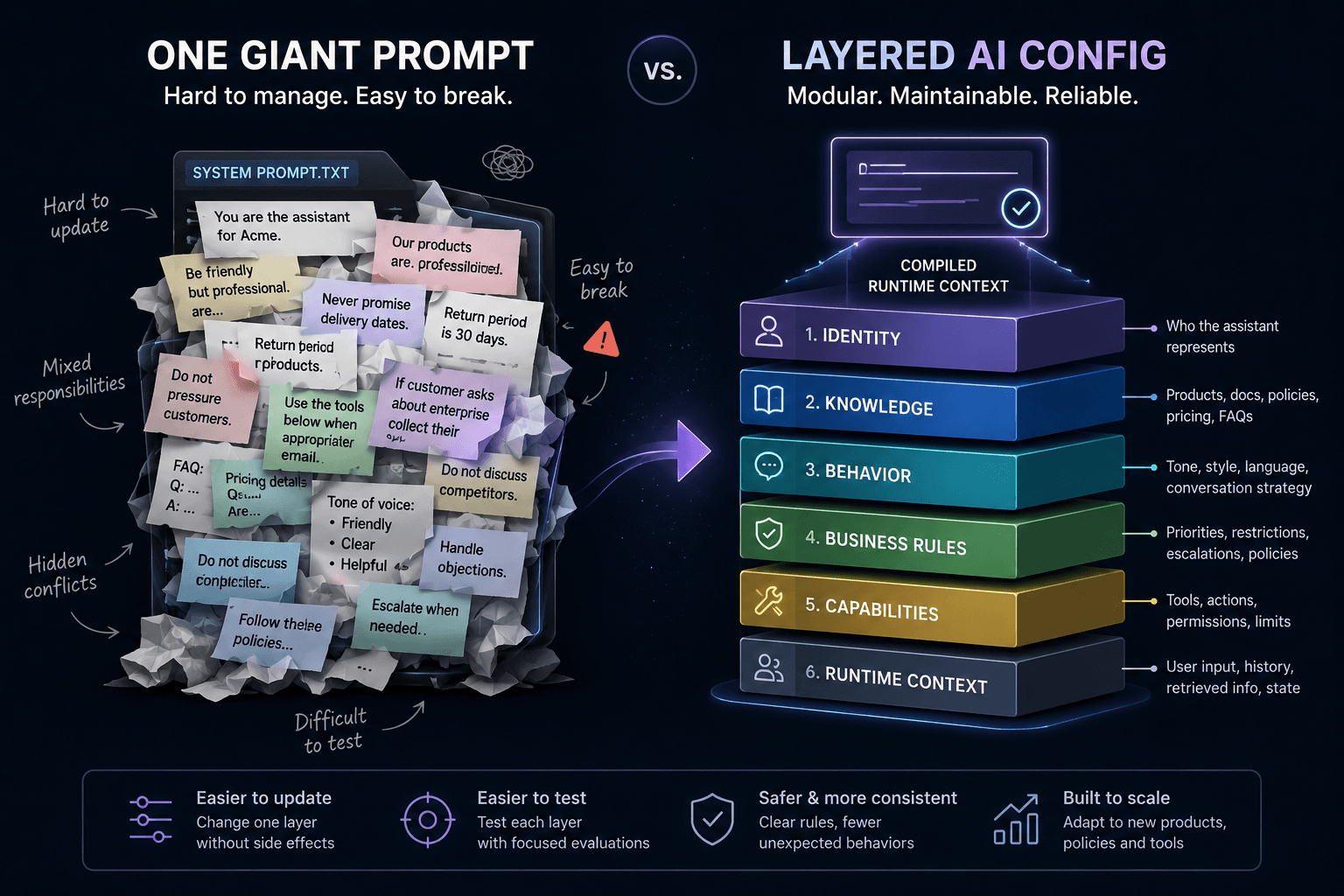
Separate brand, business, and marketing rules so your assistant stays consistent as you scale.