Anhora
Most businesses don't need an AI assistant that occasionally produces brilliant answers. They need one that behaves consistently across thousands of customer conversations.
Artificial intelligence has reached a point where impressive demonstrations are no longer difficult to find.
Ask almost any modern language model a challenging question, and there's a good chance it will produce an answer that feels surprisingly insightful. Social media is filled with screenshots of brilliant conversations, creative ideas, and moments where AI appears almost magical.
Those moments are exciting.
They are also an incomplete way to evaluate an AI assistant.
For businesses, success isn't measured by the single best response an assistant can generate. It's measured by how reliably that assistant behaves across hundreds or thousands of conversations.
That's where consistency becomes more valuable than cleverness.
Most AI demos are designed to show the assistant at its best.
The prompt is carefully prepared.
The context is ideal.
The question is interesting.
The response is polished.
Real customers rarely interact this way.
They ask incomplete questions, change topics halfway through a conversation, make spelling mistakes, provide little context, and expect accurate answers anyway.
An assistant isn't successful because it occasionally produces an exceptional response.
It's successful because the thousandth conversation feels just as dependable as the first.
Consumers often remember the most creative AI response.
Businesses remember something else entirely.
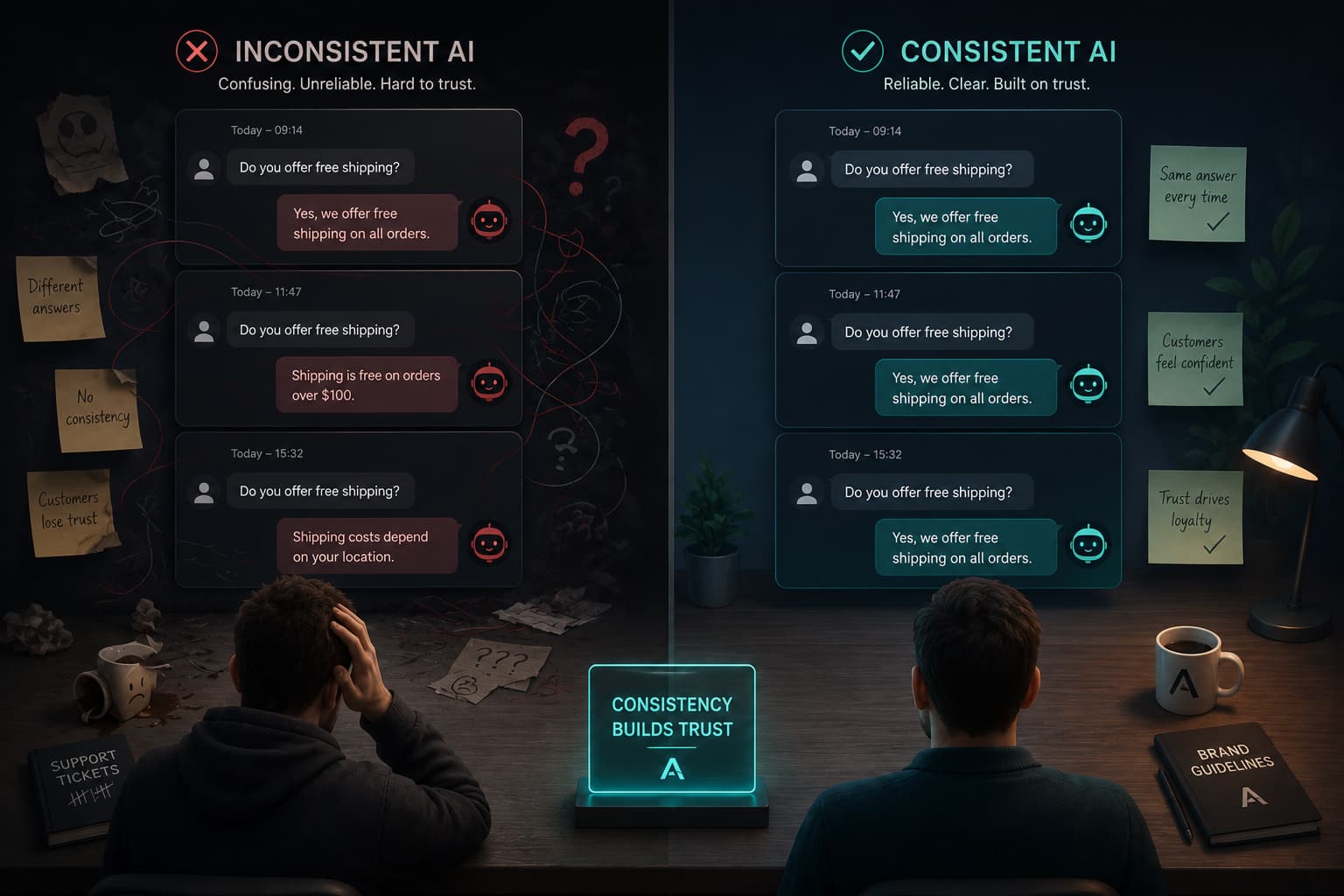
They remember when two customers receive different answers to the same question.
Imagine an online store.
One visitor asks about shipping costs.
The assistant says shipping is free.
A few minutes later another customer asks essentially the same question.
This time the assistant responds that shipping depends on the destination.
Even if one answer is technically correct, the inconsistency immediately creates uncertainty.
Trust is difficult to build and surprisingly easy to lose.
For businesses, predictability often matters more than creativity.
Many AI assistants are described as "connected to your documentation" or "powered by your knowledge base."
That's important.
But knowledge alone doesn't guarantee consistent behavior.
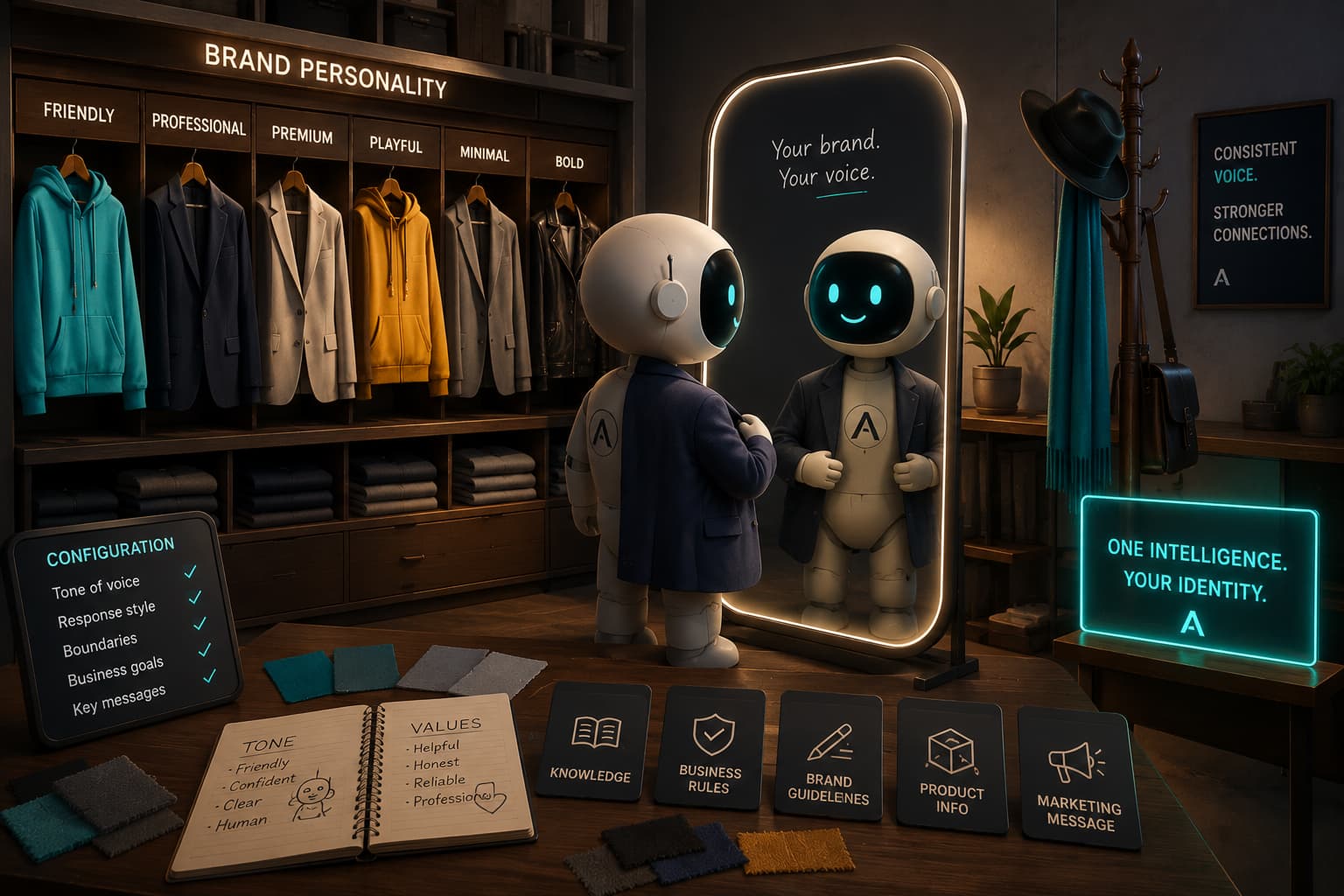
An assistant also needs to understand how a business communicates.
Should it recommend products directly or remain neutral?
Can it discuss competitors?
How should it respond when it doesn't know an answer?
Which topics should always be escalated to a human?
These decisions shape customer experience just as much as the underlying information.
Reliable assistants combine knowledge with clear behavioral expectations.
It's tempting to think consistency is simply a property of the language model.
In reality, it's the result of the system built around it.
Configuration.
Knowledge.
Evaluation.
Review.
Iteration.
Businesses don't improve their assistants by writing one increasingly complex prompt.
They improve them by continuously refining how the assistant behaves, how knowledge is maintained, and how responses are evaluated over time.
The language model is only one part of that process.
No AI assistant is perfect.
Customer expectations change.
Products evolve.
Documentation grows.
New situations appear every day.
The goal isn't to eliminate every imperfect response.
The goal is to identify patterns, learn from real conversations, and improve behavior continuously.
Reliable assistants are built through measurement, feedback, and iteration—not by assuming the first version will always be correct.
Customers rarely expect perfection.
They do expect clarity.
They expect honesty.
They expect predictable behavior.
An assistant that occasionally produces extraordinary answers but regularly contradicts itself will ultimately create frustration.
An assistant that communicates clearly, stays aligned with the business, and behaves consistently earns something much more valuable:
trust.
As AI becomes a standard part of digital products, the conversation is gradually shifting.
The question is no longer:
"How intelligent is this assistant?"
Increasingly, businesses are asking a different question:
"Can we rely on it?"
That distinction may prove to be one of the most important shifts in the next generation of AI products.
Because in the long run, reliability isn't less exciting than cleverness.
It's what makes AI genuinely useful.
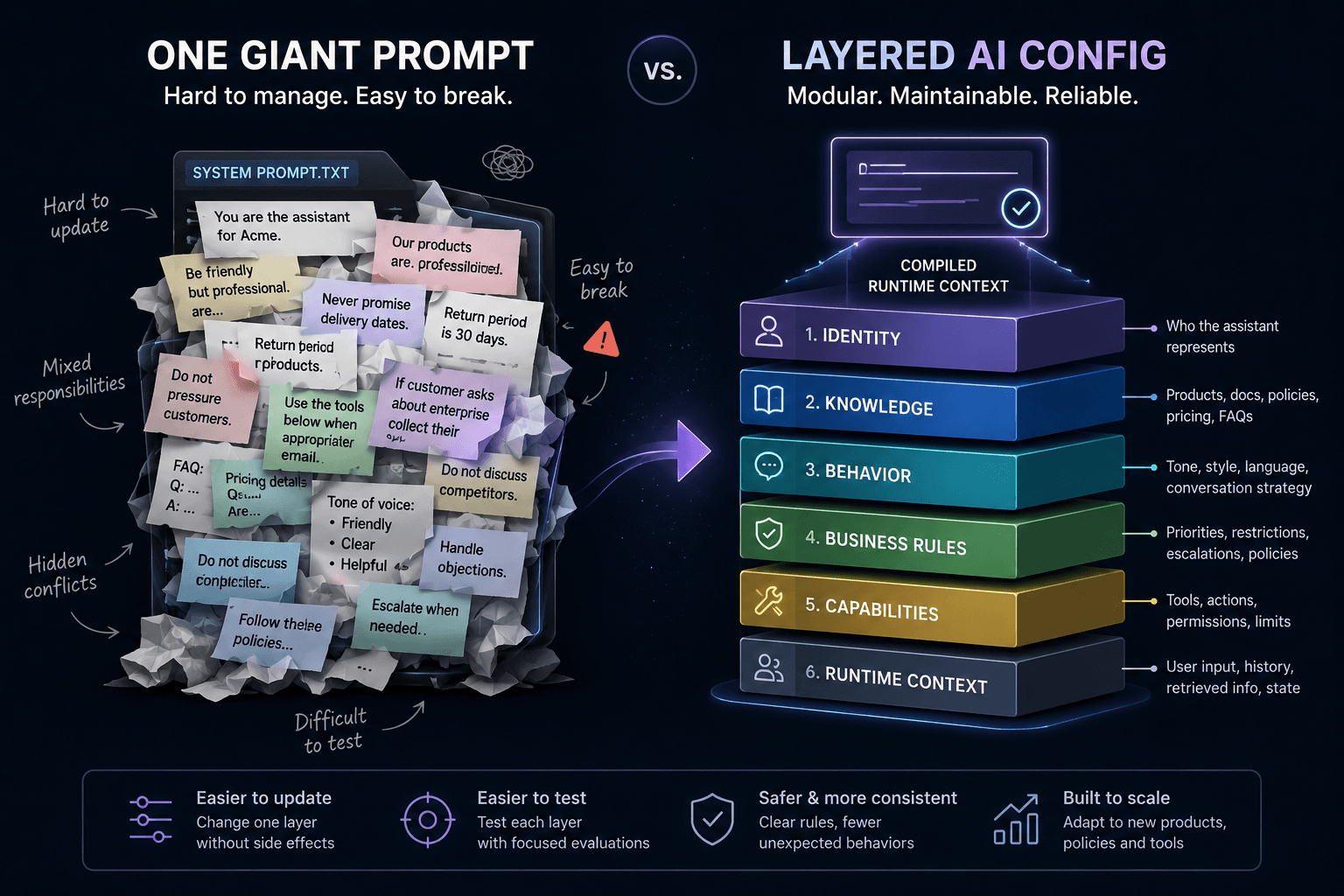
Separate brand, business, and marketing rules so your assistant stays consistent as you scale.